Only in such an idiosyncratic culture could a writer make a living dissecting and analyzing the vapid and morbid obsession we have in North America with celebrity pop-culture. Millions of people every day enjoy reading, watching and sharing opinions about why we act the way we act, listen to the music we do, celebrate the famous people we do.
Intellectuals are no exception. To send scholars at the minutiae of our indulgence is in itself an indulgence only we could afford.
Lately however, I am finding myself increasingly curious if a person such as Chuck Klosterman exists in China.
I cannot read Chinese, so my attempts to search for a Chucky Kwan type pop-culture swazi have been hindered. But in my mind, if Klosterman and Thompson can make turning a mirror on ourselves engrossing, can you imagine what an unfettered and gifted Chinese writer could do with her topic matter?
Let's be honest here -- China is Fucked. Up.
Partially because of the disparate geography, but throw in the political status, cultural repression and constant self-conciousness, and you have a potent and fascinating mixture. Instead of questioning what is produced by Chinese pop-culture, how about wondering why there is essentially no such thing as pop-culture on mainland China? And what little of it does exist is such a sad showing.
Japan, South Korea, India; all the major Asian nations have developed a pop-culture identity to call their own. Even Hong Kong. But for some reason, not mainland China. They have always just mooched off of Hong Kong, but that's like all of Canada being defined by Roch Voisine -- it just would never happen. (I realize the irony of a Canadian accusing another country of lacking cultural identity, but Beijing and Shanghai combined already have more people than we do. So bear with me).
Why is this? I find the question tantalizing. Naturally however I do not consider myself in touch with the Chinese youth. I only know what I can perceive from my house. If you are educated on the topic, please enlighten me.
Otherwise, I am off on a search, starting tonight. Updates to come on what I find.
More people should listen to CBC radio for its magazine shows. Much like the public library, CBC radio is a wealth of knowledge often under appreciated. Not only do you learn about the world, but CBC reporters regularly win awards around the globe for their radio docuwork. Despite the ever-shrinking budget of the ceebs, it's a Canadian institution I fully believe in, heartily support and will love until my final days.
With that said, the current feature on 'Ideas' with Paul Kennedy is a three-part broadcast titled "Climate Wars".
Here is the synopsis:
About 2 years ago I noticed that the military in various countries, and especially in the Pentagon, were beginning to take climate change seriously. Now, it's the business of the military to find new security threats. It's also in their own self-interest, since they need a constant supply of threats in order to justify their demands on the taxpayers' money, so you should always take the new threats that the soldiers discover with a grain of salt. You know, never ask the barber whether you need a haircut.
But I did start to look into this idea that global warming could lead to wars. It turned into a year-long trek talking to scientists, soldiers and politicians in a dozen different countries. I have come back from that trip seriously worried...
- Gwynne Dyer
This might sound like an audiobook version of an inconvenient truth, but so far it has been much more focused on presenting the latest research and exploring little discussed consequences than it is about brow beating.
Not just "the world is ending" but having respected minds discuss how that might happen politically, culturally and environmentally helps really lay things out with a different perspective. Moreover, it explores both sides, weighing the consequences of ecoengineering, ecoterrorism and how both those evolutions are impacting the world on a political level for both good and in many cases, not so good.
Probably one of the most informative pieces of journalism about our current climate (literally and otherwise) that I've ever enjoyed.
You know how technology kind of creeps up on us, but becomes entrenched so quickly in our lives that we don't even remember what life was like before the internet or cell phones?
A similar phenomena is currently taking place in bars all over and having thoroughly listened to the Passion Pit album this week, I've decided it's time to extoll the return of white people to the dance floor.
Welcome. We've missed you.
You see, for the longest time, White people completely owned the floor. Waltzing, foxtrots, flappers, the charleston, the twist. Remember when Footloose came out? Disco? The hustle?
White people used to dance. In dance clubs. It was cool, and it was the cool thing to do.
But then... then came hip hop. Because hip-hop proved to be such a culturally embedded art form, white people never really were able to appropriate hiphop to the same complete extent that they consumed jazz, or rock and roll.
To this day, despite Eminem's best efforts and rabid consumption of hip-hop by white suburbanites, ownership of the music is still inexorably linked to black culture, and as such ownership of all dancing and dance-like movements (i.e. breaking, popping, locking, and various degrees of getting jiggy, leaning and nodding very, very slowly). The stigma of white hiphop has not been overcome, and as a result, white people are uncomfortable dancing freely, although they most certainly will try their best to emulate the actions of black people dancing -- mostly out of respect for the form.
But when you see white people dancing to Beyonce at a club, let's be honest -- that's not how white people dance. If you've ever seen the Chapelle show skit with John Mayer and ?uestlove, you'd know that in their natural habitat, surrounded by fellow white people with approved white music playing, this is white dancing taking its natural course:
Within the last two years however, slowly but surely, there has been a relatively new genre seeping into bars and clubs -- white dance music. And not European white, commonly referred to here as "Gino beats", or "Techno". No, I am referring to homegrown, North American music, made for dancing.
The sample above features a Santogold song, which is not prototypical of the genre I speak, but still somewhat relevant as according to the white-hipster rulebook (section 143.2d) she is an approved artist under the white-dancing protocol of 2003.
You see, what started with a few dance infused indie rock bands (the Rapture, !!!) and extended into djs (Daft Punk, Girltalk) has naturally evolved into a whole new genre that, although seemingly ubiquitous to us today, is actually quite new -- indietronicpop.
To be honest, the genre is so popular yet actually still so new that nobody has coined an all encompassing term yet, like how "Emo" came to eventually represent all melodic power pop punk and metal.
Helping to pave the way on the pop side of the equation was Dntel and Ben Gibbard, who together put out the Postal Service, a forbearer album that led hipsters to add synths and midi to all the folk songs they had been recording in Garageband.
Sometime in 2005, after Kanye West was awarded honorary hipster status, white indie artists became comfortable enough with certain minority artists (but not all. The list was essentially Kanye, MIA, The Roots, NERD and TV on the Radio, who don't rap, but were black and played indie rock. This strange juxtaposition helped join this bridge from the non-white side of the equation, as did Lupe Fiasco and Pharell, who liked to pretend they could skateboard -- a decidedly white hobby until about 3 years ago) to appropriate not the actual essence of black music, but at least some of the tools used to create it -- tools which could be borrowed and reutilized to form their own, more comfortably familiar beats.
Thus 808's and record sampling began to be common place in the vintage clothing crowd.
The movement began gaining momentum.
Now, we have clearly reached a tipping point. With bands such as LCDSS, Cut Copy, Justice, Hercules & Love Affair and Passion Pit, white people have finally found their way home.
Walk into any hipster hangout on a weekend now and the days of shoegazing, toe tapping and headnodding while leaning against a wall are long gone. No, today you will hear falsetto's blaring, synths, heaving bass and people dancing drunkenly and uncontrollably -- the natural state of a white person dancing (it's been downhill since Fred Astaire), emancipated from the coolness associated with dancing to hiphop, and the monopoly hiphop had on rhythm until just this decade.
Here, in three short videos, is an abbreviated evolution of hipster dance music.
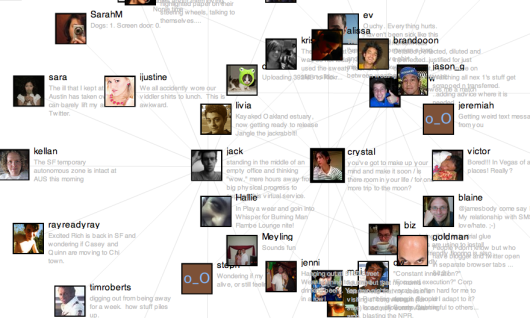
The VT incident was a glimpse, but right now in Iran, students and tech savvy reformists alike are using Twitter as the tool of choice for instant and first-person communique coming out of Tehran and the tumultuous protests going on right now.
I can't think of another situation where one was able, in real time, to access the thoughts, sights and messages of so many people concerning one event.
Can you imagine if this was possible during 9/11? People would be tweeting their location in buildings. Rescue services would be checking it for information. Pictures would instantly have been sent to the outside world.
This marks a pretty powerful point for social media, with the U.S. State Dept. even admitting it pressed Twitter to hold off on a scheduled maintenance to allow Iranians to continue using the site as a point of reference on source of information.
Ingenuity has allowed many Iranians to continue using the site through proxy servers, getting around the general bans the government has levied against cell phones, text messages, email, facebook, blogs and even twitter itself.
Yes, 90% of the comments I receive in twitter are asinine. But when something like this happens, the potential of not just the internet, by social networking is plain to see.
If McLuhan's global village was a tribalized network of communities that redefined individualism, social media has perhaps ushered in a evolved state of the village -- one that modifies what we deem individual but more importantly, what we consider to be our tribe.
I am fascinated by what's going on in Tehran. The political repercussions of the reformist backlash cannot be understated -- the potential for change is most definitely in the air.
But perversely, I am even more fascinated by what's going on on Twitter.
As important as the tool has become, I truly believe at the end of this, the true winner will be the mainstream media. It may not look like it now, because compared to Tweets, the 6pm news is painfully outdated and slow to react to breaking events. But the vetting process of true journalism cannot be undervalued.
It's great to get breaking news from the mob. But the wall of noise eventually gives way to deeper questions -- who can you trust? what information is accurate?
Unlike a lot of others, who believe social networking is "the new journalism," I think that's simply not true. Journalism will always be sharing of stories in an accurate, timely fashion.
Twitter is but another tool. But perhaps one of the biggest we've seen in a generation.
On the morning of September 11, 2001, I stood slack jawed, standing in the hallway of the Richard Ivey School of Business having just left my first ever university english class.
CNN was on several TV's overhanging the dimly lit linoleum hall. Hushed voices and wide eyes mingled reacting to the stuttering commentary coming from the television as dozens of us stared in awe at the unbelievable sight of an airplane smashing into an iconic New York landmark -- then horror as that landmark came crumbling down to the earth. It was hundreds of miles away, but we could feel the dust flying at us through the screen. The fear at least, was most certainly palpable.
Before 9/11 however, there was 6/4.
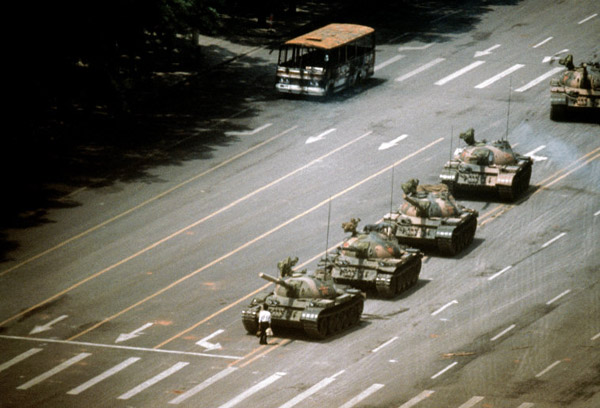
As much as one act of terror defined a generation (and many to come), on June 4, 1989 an act of courage inspired the world.
More iconic than the tallest building in the world, selected as symbols of capitalism, one Chinese student stopping a battalion of tanks by himself idealized notions of freedom, democracy, humanity and self-determination to a world in the grips of political conflict.
Blood was shed that day. On a pivotal moment that to this day defines the Chinese government and to a certain extent, it's people, freedom lost the battle in Tiananmen -- but it won the war.
Five months later, the Berlin wall would come crashing down. Two years later, the Soviet Union would be no more.
We speak often of tipping points, and in this age of over-saturated, over-analyzed, over-blown media coverage, hyperbole is part and parcel of information dissemination.
I was seven years old on June 4, 1989. At the time, the events were lost on me, the symbolism and gravitas of the situation blissfully irrelevant compared to the opportunity to stay up late into the night to watch TV, even if I didn't know what we were watching.
Little did I realize the world I woke up to the next day would never be the same. Even 20 years later.
I love China. Most would probably not suspect this, but I am proud of my heritage, proud of our tradition, proud of my family's roots and lineage. It is for this reason that we privileged enough to live here in Canada shouldn't ever, ever forget 6/4, and what it means as a moment in humanity shared not just by our home country, but inspirational to people all over the world.
Most importantly however, is that there is still much work to be done. Those who would purposely choose to ignore history seem to be ignorant of the fact that they are setting themselves up to repeat it.
Hopefully next time, the pendulum will swing the other way, and yet another date will go down in the annals of humanity not for tragedy, but for victory.
Perusing the new Globe&Mail today (side note: love the site, hate the long loading times. Lots of potential but the back-end clearly has some loose ends to tie up), and stumbled upon this story out of the Vancouver desk about Marriage stability and children. Here's a quote:
Today's parents seem prepared to set aside all kinds of pleasures to nurture a child – from their sex lives to careers, not to mention happy-hour beers – but there's one thing even the most kinder-friendly couple is loath to give up: their marriage.
And when one child rocks the marital boat, a growing number of couples are sticking with just one to keep their union strong.
That doesn't make them wimps, though. In fact, research suggests that children are more taxing on marriages than they used to be.
Essentially the article discusses how many modern couples are stopping at one child because having children is so stressful, and after struggling in their marriage to raise one, many don't want to go through it all over again and again. It actually goes so far as to posit that happiness is inversely proportional to how many kids you have, citing a 2005 study that determined mothers with one child were happier than those with multiple children.
There's nothing wrong with this story. It's well written, and although it's based on some entirely anecdotal quotes backed by "evidence" of studies that are as dependable as a GM stock option, these are more symptomatic of a leaky premise than they are of shoddy writing.
I guess upon reading this, more than anything one has to reflect on the cultural context from which this story was made possible. Clearly, nobody would have written this article in 1940, even if they had the concrete backing of a Danish sociology professor circa 2005.
Attitudes surrounding the entire concept of marriage and family, and the many interrelationships that compose those two entities, seem infinitely more complex these days than they once did. And for the most part, those complications stem from a forward march to break down what were once the most concrete of human connections; your spouse and kids were once inescapable, really, but we have moved into an era were if something doesn't quite work for you, it's completely possible to move on.
I am not casting judgement. I simply find these paradigm shifts fascinating. The implications of familial relationships, if you think about it, really has a hand in almost all the cultural and social evolutions of the last 10-15 years, both in the liberal movement and the aggressive partisanship rift that ensued.
How have social values changed? What is important to us now, asides (and likely after) ourselves? How much of every decision we make every day is painted by these broad cultural engravings and, looking back, how did today's seemingly quaint ideological cliches dictate the ebb and flow of generations past?
When it boils down to it, I guess after reading that article, I really was left wondering only one thing:
Why are these parents having kids in the first place?
I have a feeling if they can answer that question honestly, then deciding whether or not to have another one shouldn't be a very difficult question at all.
Can you imagine actually hanging out at a physical place called Asian Avenue? I shudder to think.
I've had a few conversations recently about social networking sites such as Facebook, Twitter et al. It definitely seems that within the last two months, Twitter has absolutely exploded.
My question might be whether someone's internet promiscuity is actually proportional to that individual's real-life social activity?
Is a social networking butterfly (somebody with, say over 800 friends on Facebook) by definition also a social butterfly in real life? I suppose the more pertinent question however might rather be whether exceptions are possible.
What is the correlation between real personality and one's online presence?
Technological inclination surely has a role, but how is that connected to one's self-awareness and desire to blog, tweet or otherwise make your life more transparent to those around you (or at least, appear more transparent)? Can a personality profile be created for your online persona, and are there concrete connections to reality?
In my most rudimentary of observations, I think that people who embrace social networking openly are, generally, not necessarily more extroverted, but by-and-large more willing to make new connections.
In other words, someone who tweets constantly would probably be easier to become actual friends with than someone who doesn't have a Facebook account because they are think it's cool to be ironic.
Of course, this is even more convoluted because I think there are also plenty of cases where people are extremely promiscuous online because they are socially awkward in real life. So how does one account for that faction? Hmm...
It's all very curious. Academic studies haven't seemed to really start analyzing this relationship yet and how one affects the other, but I can honestly see the future of our communications being completely integrated into social media as "the new medium" of choice... if it isn't already, that is.
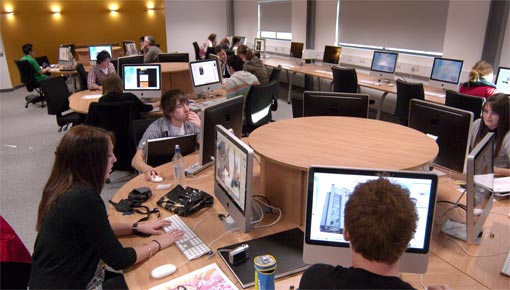
Was listening to CBC Radio this weekend and they were having a show discussing the relative merits of technology in the classroom.
One side posits that an over saturation of "new media" has occurred, with phones, music players, games, computers, email and social networking, so ubiquitous that learning has become nearly impossible to focus on. Notice I used little quotes around new media, since technically social networking is not a new media, but... it just might be the next evolution. As Mark Cuban succinctly put it in his infamous tweet; "the medium is no longer the message. the network is."
The other argument of course, is that all this technology is a boon to education. It is easier to learn with computers, and programs, and podcasts and ways to connect, interact, visualize, conceptualize and analyze. All the reasons we love technology in the first place. It makes life easer, and makes what might otherwise have been impossible, very simple.
The callers were of varying usefulness, particularly one girl who said she was 25 years old, and that when she was in high school she "barely had any computers," and "used overhead projectors mostly." Also, she claimed technology was making kids today dumber, according to her completely scientific opinion. Nevermind the fact that I am 26, and distinctly recall programming in a huge computer lab in high school that also included a Mac lab. Oh, and we had a graphing/CAD lab too, which naturally used computers. Slide rules can be so cumbersome, you see. But I digress.
One question that was not discussed however is the only one I have been mulling over still on and off for a few days. Undoubtedly, today's younger generation are tech savvy. But are they technologically literate? These might be defined as different things.
Sure, kids can put up myspace or blogger websites, but whatever happened to Free Hosting? With no GeoCities or Tripod like service, very few kids are forced to look at a blank page and learn to code in HTML, CSS or Flash in order to get their creation on the net. All the steps have been simplified to one-click, and thus they never have to learn the fundamental building blocks.
Isn't this the equivalent of reading to a child his whole life, but never actually teaching that child to read? Can someone be conversationally intelligent but illiterate? I don't see why not, and to a limited extent I almost feel like that's what's happening with a lot of students these days.
They understand the end product, but are sheltered from the process.
If anything, I think that's the real issue with technology in the classroom -- it's too dated. You can't be teaching stuff like "this is a mouse" to kids. There needs to be some sort of plan to actually advance them knowledge that won't be irrelevant within a year's time. Education not only needs to embrace technology, it needs to essentially become it's main driver if both are to achieve something continually useful for students of all ages.
Now I feel like I should register for some continuing education classes or something.
Stratford Festival puts 30 performances 'on hold'. That kind of sucks. Does anybody want to go? I'm sad they cancelled West Side Story though, that's the one I'd most like to see. Yea, I said it -- I like West Side Story. What? What?
Obama unveils presidential pooch. For some reason, at first I didn't feel this was newsworthy. Apparently, the BBC, the Guardian, The CBC, The Star, The Globe and the Times all did. Clearly I missed something.
Taliban execute eloping young lovers in Afghanistan. Well this is just depressing. Terrorists might bomb our buildings, and behead our journalists. But capping folks for being in love, well, you gotta be one coldheartedmuthfuckaifyaknowhwatimsayin.
Education Standards Likely to See Toughening. You know, this might be the first Obama policy I fundamentally disagree with. Essentially he's just throwing more money at the problem, but personally I'm not a big proponent of standardized testing. It just doesn't seem to provide any inherent learning skills, if that makes any sense. Then again, I don't remember anything I learned in university, so maybe it's just me.
Pirates attack second US vessel. Does nobody else find it kind of awesome that pirates are suddenly relevant news items again? Sure, they've upgraded from cannons and swords to RPG's and AK's, and instead of "Blue Beard", dudes is probably named !Xobli and all. But still. Also, why has nobody thought of sending in ninjas to free these ships and crews yet? It's so natural. Like, if I was fighting Cowboy Pirates, I'd send in a elite team of Native Indians. Easy. You just have to know your opponents weakness, y'know?
Home births 'as safe as hospital'. This one's interesting. Apparently a huge study in the UK reveals low-risk mothers are essentially just as safe giving birth at home with a trained mid-wife as at a hospital. The reason it's kind of neat to me is because I didn't even realize being a midwife was still a proper and viable career choice. I mean, I noticed it when browsing McMaster's undergraduate programs, but I had to webcrawler (pre-google-era!) it just to figure out what the hell a midwife was. For some reason, it doesn't seem like a very happy job. I'd imagine it's a lot of yelling, crying and I guess some baby delivering. But, really, if you're the husband, do you ever want to sleep in that bed again after seeing child birth? I wouldn't. Ew.
I'm totally ripping off Truehoop's bullets here, but I think it's unique in applying that approach to news. I'm probably just bored. And nobody is really ever going to read this. But it's for my own amusement, so bear with me and this way we can all have common conversation topics the next time I see you in person.
An absolutely thought provoking article in the Times about the subjects of what define art and photojournalism, and perhaps where those two are beginning to overlap. Particularly it looks at the infamous Obama red-white-blue graphic. Also, some fascinating insight into the ongoing discourse concerning art-as-appropriation. "Copyright lawyers have been arguing over Fairey’s appropriation of a news photograph of for his “Hope” campaign poster and whether it constitutes “fair use.” But no one has disputed that it is a work of art. But what about the photograph on which the poster is based?"
UConn was caught violating NCAA recruiting rules. I know this goes on everyday. Only a few days ago, there was a great article (also in the Times) about the seedy underworld of elite-amateur basketball all the way down to middle school. Am I the only one still waiting for a Nick-Nolte-from-Blue-Chips moment to actually go down any one of these days? I can absolutely see Tim Floyd walking out and retiring after USC wins a big game because he'd rather coach street ball kids on West Long Beach.
More talk from Waterfront Toronto this week, this time about renovating Queens Quay with at $192-million boobjob. Are these guys ever going to actually do anything? What happened to that Harbourfront plan? Oh, it turned into a condo. What about the Cherry St. project? On the back burner you say. East Don Lands? What? Ok, let's pour imaginary money into Queens Quay then. I like David Miller, he's got some great ideas. But please. Follow them up with action. I'll even pay taxes for it, I swear.
Oh the French. Can you imagine if, in Toronto, laid off workers of 3M barricaded the national manger in his office for a day, holding him hostage until he signed a deal to renegotiate with said-economic casualties? It'd be front page news. On the BBC website, this story barely made a squeak on the RSS feed. I kind of respect their proletariat-perseverance I suppose. Or as some may call it, "the crazy".
The CBC is letting go of 800 employees Canada wide. The Ceebs has never been a shining example of fiscal responsibility. It's a company that loses money, but is paid for by the people, for the people. Therefore, it is owned by, the people. To see it have to start selling off properties is painful, particularly when this affects a few of my personal colleagues. Hopefully the industry is going to bounce back eventually, or I'll be writing these blogs to nowhere for a very very long time.
North Korea is apparently going ahead with plans to test a long-range missile, says the Times in breaking news. Oh KJI. You whine about sanctions, run your country on hay, your people sleep in the dark because you don't have enough power, and yet you're building weapons... why? Even if you can get a single working nuke, do you honestly think you'd have the wherewithal to actually harm anybody but yourself with it? You're being watched by the world like Michael Jackson at a daycare centre. For pure entertainment though, you can never go wrong with a good North Korea story.
The Raptors won last night, but really, there is no winning with this team. Ever. Just look at the talent on our bench. We're horrible. Even our starters are suspect at this point, when they're not out ducking alimony payments and such. For the rest of this season, I'll be rooting for the Suns, who are keeping the hope alive with a tense win over Utah last night. Grant Hill turned back the clock big time. That's the difference between the Suns and the Raptors. Their glue guy is a former NBA MVP. Ours is a former Euroleague MVP. Oh well.
And finally, something to really get excited about.
 Chuck Klosterman could only exist in America.